

Canine Body Language – We are always saying, “If our dog could talk, I wonder what they would be saying?”
Well even though dogs can’t speak to us, they have their own ways of letting us know how they feel. Read on to understand more about your dogs basic body language.

We hope this will help you understand your canine’s body language a little better!
Despite animals such as fish and reptiles becoming more popular, dogs are still the most numerous pet in the UK today with 23% of households owning at least one dog. Unfortunately, the number of dogs in rescue centres is at a record high; some blame the recession, but in most cases, the owner simply cannot cope, often with behavioural problems being the cause. It is very common for people to take on a dog without fully understanding their needs, this can and does, lead to serious problems. Although the majority of dogs are rehomed, a large number are put to sleep every year as they are deemed unsuitable for rehoming or, it simply compromises the dog’s welfare to keep him in a rescue centre for any length of time. By far the biggest reason why dogs end up in rescue centres is people’s misunderstanding of the dog as a species.
In this article, you will gain a better understanding of canine behaviour problems and possible solutions to these problems. Before we can look at common behaviour problems and their solutions, it is important you learn about normal canine behaviour (will cover this in next weeks blog).
Apart from helping you gain knowledge, the underlying aim of this blog is to provide you with an appreciation of what it is like for a dog to live in a human society and trying to make sense of human gestures, language and intentions.
Body Language
Recognise & understand canine body language & behavioural signs of emotions.
Dogs have been changed through domestication and have become ineffective predators. However, some individuals can still be successful hunters. In fact, humans, to exhibit certain parts of the predatory sequence of behaviours, have selectively bred most dog breeds.
The complete predatory sequence is eye – stalk – chase – grab – bite – kill – bite -dissect and consume. Greyhounds and other sight hounds have been bred to excel in the chase part of this sequence. Scent hounds, such as Beagles and Basset Hounds, are good at pursuing their quarry’s scent trails. Pointing breeds specialise in stalking and flushing birds. Herding breeds are also accomplished chasers and stalkers, but they concentrate their efforts on controlling the movements of livestock. Terriers outrival other breeds in their ability to capture and kill unwanted vermin, like mice and rats. Dogs are cursorial predators, meaning that they chase down their prey. The dog’s visual system is highly adapted to detecting movement. With the slightest motion often triggering a dog to give chase. High-pitched squealing sounds, like those a prey animal makes when frightened or injured, can also trigger an attack. Some dogs lose interest once a prey animal stops moving, that is why opossums, whose defensive response is to play dead, often survive dog attacks. However, many dogs will play with the body of an animal they catch and some will consume their prey.
The Domestic Dog
The domestic dog has the same social nature found in the Wolf (as part of their genetic makeup) and has a need to live within a safe, orderly social group. In the past, dog behaviour was interpreted quite simplistically in terms of ‘hierarchy’ or social structure. (Pérez-Guisado, J. and Muñoz-Serrano, A., 2009).
It was believed that dogs had a natural drive to achieve a higher ‘status’ relative to other dogs or people and that this desire led them to show behaviours such as aggression in order to achieve control. This idea came from early studies on captive wolves (Zimen, E.,1975).
The concept of dominance is often used in discussions of canine behaviour. It has had many implications, especially in the world of dog training where for years’ dog owners were encouraged to ‘dominate’ their dog.
More recent research on wolves (Mech, D. 1999) has found that the natural social groupings of wolves are actually based on co-operative family groups of parents and offspring, with very little aggression. After observing wild wolf packs in Canada he concluded that the behaviour of non-captive wolves is very different from captive wolves.
In non-captive packs, there is a natural order based on age. During 13 years of study, he did not once see dominance contests within the packs.
Much of the so-called dominance behaviour is actually resource guarding. Relationships between dogs in a multi-dog household are very fluent and will depend on upon the actual resource and how strongly they wish to guard it.
Dogs are highly social. This social lifestyle has allowed them to survive for thousands of years, making them efficient hunters and even enabled them to integrate themselves with humans. We should aim to be an educator, carer and guide. There is no need to ‘dominate’ dogs or to try to be an ‘alpha’. Dogs recognise we are not dogs – after all, how many dogs do you see bringing a ball to another dog for a game of ‘Fetch’?
So, how do dogs express themselves? Answer: Communication.
Auditory
Dogs use several forms of verbal communication, including high-pitched-yaps, whines, whimpers, and howls. Whines and whimpers may be an indication of either physical or emotional discomfort. Puppies often whimper to gain access to their mother’s nipples when hungry. A yap might be heard when a dog is suddenly frightened or hurt during play or ritual combat.
Dogs howl alone or together for a variety of reasons. For example, to notify other dogs of their whereabouts such as when they wish to attract a mate, rally the “pack” together for the hunt, when distressed, during or after playing and other social interactions.
Visual
Body language plays an important role in canine communication. Dogs have a very complex series of expressions and postures that are used to communicate with each other. The most obvious use the face and the tail. The posture of the ears, eyes, mouth, and tail communicate a lot about a dog’s mood and intentions.
Olfactory
Dogs make continual use of their superior sense of smell even when communicating amongst themselves. There are scent glands on their cheeks, behind their ears, on their hind paws, the top of their tail, and on their anus. Their faeces, and especially their urine act as olfactory signals to other dogs. These bodily scents give information about the animal’s age, gender, health, mood, and even sexual arousal.
Scent Marking
Scent plays an important role in canine communications. A dog is capable of smelling the details of an odour a hundred times more accurately than a human being. Dogs have good vision, but really do not trust their eyes, and rely on their sense of smell to identify their territory and each other.
Meeting/Bonding
A male and female meet. They stand shoulder to shoulder, not gazing directly into each other’s eyes, but in a mutual non-threatening position; both seeming hesitant to back off or advance. Within a few moments, one or the other will break the ice and attempt a muzzle sniff, perhaps followed by tongue-flicking and/or nuzzling the other’s cheek or lips. Eventually, the dogs relax determining that no threat exists. Bonding then begins with running, playing, mutual nuzzling, licking of lips and noses, grooming, parallel walking, sniffing of each other’s anus, genitals, and urine, and will also double mark.
Courtship
Intensified bonding behaviour with the addition of one dog standing over the other, playful attempts at mounting from the front or side (sometimes called “riding up”), actual licking of the anus and genitals, parallel running which often incorporates nuzzling under the other’s jaw or ear while in motion, pricking ears sideways while in each other’s presence. The female generally enters pro-oestrus during this time; her vulva swells and often bleeds. The male’s arousal increases, becoming more apparent as his testicles grow more apparent in the scrotum.
Copulation
Copulatory behaviour begins when the female enters estrus. She will flag the male and assume a posture sometimes called lordosis, where the hind legs are stretched back, the tail is averted, and the back is arched to lower the vulva to an optimal angle of entry for the male’s penis. The male will then mount from the rear.
Hopefully, you will recognise some of the behaviours described above and now have a better understanding of why dogs act in this way. It is interesting to note that some of Wolf’s natural behaviour is retained in the domestic dog’s behavioural repertoire.
Body language is the main form of non-verbal communication used by dogs:
Tail Postures
This high tail position indicates the dog is a confident dog.

This horizontal, stiffly-held tail position indicates the dog is alert to something.

The wagging of a dog’s tail in this manner indicates that the dog is relaxed.

This somewhat drooped tail position indicates the dog is relatively relaxed.

This drooping tail position indicates the dog is even more relaxed.

This half tail tuck along with a partially arched back indicates the dog is in a form of submission.

This fully tucked tail along with a highly arched back shows that the dog is in fear of something.

Body Postures
This body position is shown by a dog when he is defensive or is feeling threatened.
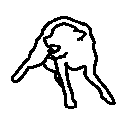
This body position is of a dog fighting with the top dog pinning the other dog to the ground. This can also be seen in ‘play’.

The body position of the dog lying down is an example of a dog being passive submissive.

This type body position when running indicates that the dog is playing.

This type body position when running indicates that the dog is running in fear.
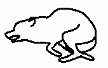
The dog on the left side of this illustration demonstrates the way a dog looks when showing submission.
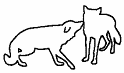
This dog is simply playing.

This shows how a young dog may submit to a confident dog.

Although there are distinct differences between wolves and dogs, (after all they are two different species), such as the absence of a bark in wolves and other communicative behaviours, there are some similarities. Dogs are often humanised and unfortunately, it is common practice to punish a dog when they do not understand what we tell them.
Canine body language is something we can only learn to understand by observing dogs as much as possible. The signals they use are often very subtle and easy to miss if you do not know what to look for.
Below are some links that allow you to watch some dogs interacting with each other, some of the videos having some good commentary talking through each interaction.
Please watch each video closely.
Number 1 ‘lip lick’ (a calming signal): http://www.youtube.com/watchv=6_lgiP_Tnc0&NR=1&feature=endscreen
Number 2 (a snap and warning):https://www.youtube.com/watch?v=JVaCsgUpQeE
Number 3 (series of slides on body language):http://www.youtube.com/watch?NR=1&v=00_9JPltXHI&feature=endscreen
We will follow on next week with more ways to interpret your dog and his body language, don’t forget to tune in (as it were)!
My Best Friend Dog Care Services
At My Best Friend we offer a range of dog care services including Dog Walking, Doggy Day Care, Home Boarding, Pet Sitting and Puppy Care. We work hard to provide a caring, convenient and professional service to your best friend and we take pride in treating your dog as if they were our own.